


You were there incredibly early, before ‘rave’ had really settled into being a defined culture. What did those first parties actually feel like from behind the equipment?
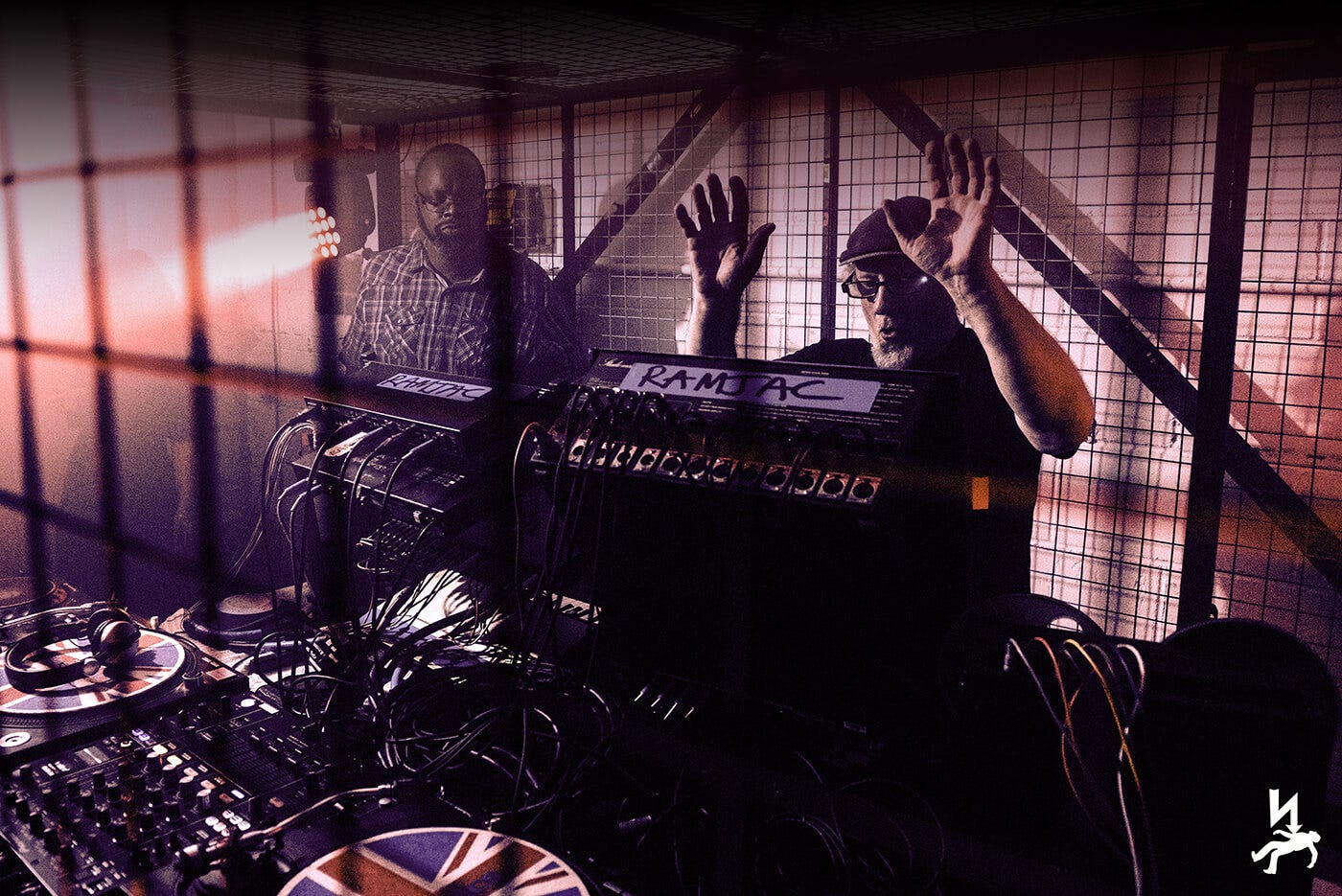
I’d heard about warehouse parties and ecstasy before I got anywhere near such an event. In 1987, I got to play percussion in a post-Pigbag lineup at a warehouse party. My hands were double the size the next morning. No monitoring. Amazing party though. Tripatronics! In late 1988 I played my first live Ramjac set at a Live Wire party at BBMC rehearsal studios in Dollis Hill, with two Emax samplers and an Atari. Dr Das was on drum machines and 303. We may have had percussion set up too; it’s a bit of a blur, but I remember a DJ played a promo of Longsy D’s This is Ska, which was released officially in January 1989. This time, my monitoring was permanently on. I thought it would be fun to play some of my Lee Perry vocal samples over the top, and this guy came up to me and handed me a very long unlit spliff, saying, “Thank you for playing Lee Perry over my track!” There was another guy high up a ladder all night - all night - shirt off, glistening with sweat, pumping his arms in front of a spotlight with a different coloured lighting gel in each hand.
I played there repeatedly over the next few years. Promoter Finbarr came round with a milk churn once, ladling out guarana-milk to the dancers in the middle. At the Fundamental parties, I’d look out from behind the Atari, and if people were dancing, I knew I was doing something right. I was a bit naive, though; I hadn’t reckoned on “live PAs” being mimed, but that was a sad trajectory, and why we value those early parties so much in particular. Orbital’s first gig was something to behold, and even the guy at a Pyramid Arts rave (adjacent to today’s Cafe Oto) who came on and, in a most un-London manner, said “Hi! My name’s Moby, I’m from New York!” And slammed into Twin Peaks. Showing up with a record in 1990, I’d already felt like a bit of a latecomer, but it was all going on.
Before Ramjac, there was Paul the percussionist. Where did rhythm start for you?
I was an incessant tapper in the back of the car. I was an air drummer to the Beatles on the telly, shouting yeah yeah yeah! Pop music was called Beat music. I grew up with it. Simultaneously, we used to march around the living room with saucepans on our heads to the sound of the Kneller Hall military brass bands. That’s all about bass drums, snares, cymbals and keeping in step.
By the time I was 16, I’d been learning guitar for 8 years and didn’t much care for it until punk. Once I was told the class next door could hear me thrashing an acoustic and the teacher said, “He only knows two chords, but he has a good sense of rhythm!” I still play it.
You studied with John Stevens and Isaac Tagoe, as well as studying West African and Cuban percussion. What did those traditions teach you that a drum machine couldn’t?
The rhythms, the hand techniques, the dynamics, the polyrhythmic interplay which I did put into drum machines, the calls, responses, the form, accents and regional variations of dialect helped me understand that my own rhythms were as meaningful as anyone’s, justifying my lack of interest in playing Latin or African music, preferring the trajectory of the musical traditions in UK music culture surrounding me, with the instruments of my choice, largely Latin and African! Another obvious answer would be grooves, but I found that good programming with no swing whatsoever can make a drum machine groove in its own way.
When you first started programming electronic rhythms, were you consciously trying to make a machine behave more like a percussionist?
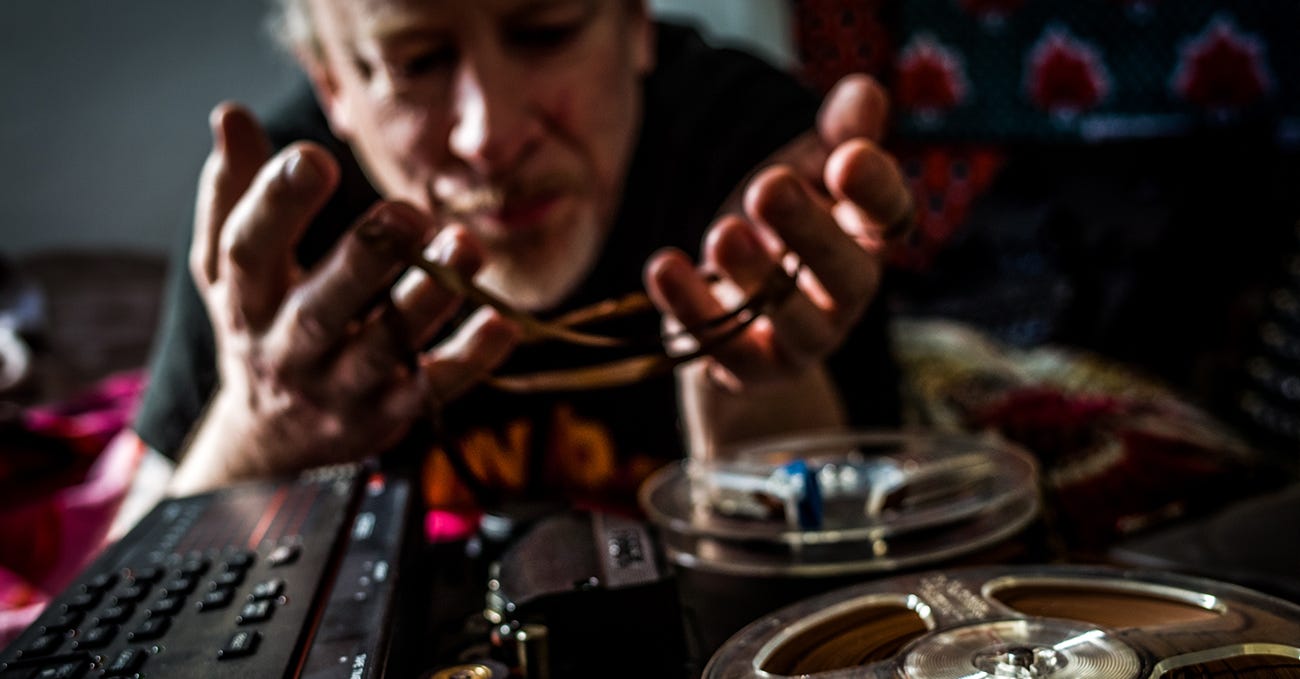
Yes, although I understood that the role the drum machine needed to play in the context of the music I was making then, generally labelled house, electro or hip hop, was to lock down the dancefloor with kick, hat and snare and fit in with the music either side of it. I knew that a drum machine programmed in West Africa would have a different outcome altogether, and that is amply demonstrated nowadays in contemporary global electronica, where freedom from the tyranny of the four-on-the-floor can readily be found. House music has been brought to Abuja and has its place, but even British Afrobeat turns the rhythms of house music upside down.
Also, the percussive elements of rhythmic ensembles were well recognised by Roland et al.; the 808 clave, cowbell, congas and toms already echoed across early electronic forms. The two-bar clave pattern of Afrocentric music was immediately represented in electronica and still is. Studying its source was a confirmation for me and a basis for expansion.
My own drum machine was, and still is, a Sequential Circuits Drumtraks, which has a four-instrument percussion section sharing one monophonic output. I would start, for example, by transcribing a Ghanaian shekere rhythm onto the Drumtraks’ cabassa sound, the closest approximation to a shekere it offered. I then programmed the clave rhythm into its cowbell sound: the cowbell is traditionally used in West African music to play this rhythm, and the Drumtraks had no dedicated clave sound.
The shekere and cowbell patterns would battle for the output. Deleting notes from the busier shekere pattern to allow the clave to sound cleanly would leave a lovely interplay, and muting the cowbell volume whilst still playing the notes produced a great cabassa “anti-rhythm”, as I enjoyed calling such things.
Do you think your background as a drummer explains why Ramjac tracks often feel less rigid than a lot of sequenced electronic music from the period?
Partly. My choices of samples and loops in the early days, their edit points and tuning alongside careful tempo settings, sometimes doubled in resolution, also helped. I wasn’t using the same sample sets as I heard going round. I did an experiment once with some of the well-used JB breaks to see what they’d do in my own context, and one Hot Pants break survived. Truth be told, I’m not sure what all the breaks or samples are now. On 100hz I have something that’s just named 44th - so I guess I sampled something on 44th & Broadway. I’ve sequenced it with the snare starting on the 1 and retriggered it to jump around in a tresillo pattern - there’s an African percussion reference for you. In Reefer, I deliberately set out to keep the snare off the 2 and 4, which is held just by a handclap. Destination Unknown has Sun Ra breaks; others have Johnny Reggae and Jack Costanzo. Shh!

I would copy the rhythms in some of the breaks and transcribe them onto the Drumtraks so they could double or be interchangeable. Pre-groove quantisation, matching rigid machines with fluid playing in a break, can produce its own flavour. It doesn’t always work, so it’s always about choices and decision-making. So ultimately, yes. Ask any drummer about the importance of timing.
NB I played a lot of drumkit to drum machines and sequencers in the 86-89 period whilst attending as many conga classes as I could. In one class there was a discussion about drum machines, leading the teacher to say that a drum machine will never sound like a human being. I couldn’t help myself and said that a human will never sound like a drum machine. Tumbleweed…. Meanwhile, decades later, neither statement is true.
There’s now a mythology around Sunrise, Energy and Back to the Future. At the time, did it feel historically important, or did it simply feel like something strange and exciting happening at weekends? Was there a particular night when you realised: this has become something enormous?
It was totally exciting and also recognisably a phenomenon, unless you were 16 and thought it was normal. I remember John Peel saying on a similar topic that if you had thought that what was going on around you was historically important, you’d have to have been some sort of a weirdo. He must have been referring to me then! Imagine being at Castle Morton - which I wasn’t - and thinking nothing of it. Sunrise White Waltham, June 24th 1989 - where I was - was 10,000 people in an aircraft hangar all night going mental. That’s not normal!
3000 people in a riding stable in Iver was fantastic. Despite efforts, I didn’t make Santa Pod, which was even bigger.
Was there more freedom then precisely because nobody yet knew what electronic dance music was supposed to sound like?
Absolutely. People developed fixed ideas, though. Labels said they liked my stuff but couldn’t release it because it didn’t fit on their label. That’s why Irdial was great while it lasted. I remember in 92-93 someone asked what sort of music I made, and I said House. I played a slow version of That Delicious Taste to him, and he said - Well, it’s not house, but it’s good! I guess a tune at 110 bpm isn’t house really, is it? Not now, but then, it was part of my set, built with the same tools and thinking as my tunes at 120-140 bpm, and it came out like that. Actually, it sped up - sometimes. It does on the current release. It wasn’t hip hop or electronica; it wasn’t rock or jazz. I played it at house parties for chrissakes.
I got told off by Mixmaster Morris for playing a tune at 144 bpm when we were supporting Psychic TV at Dingwalls in 88. He came onto the stage and said: “It’s too fast!” Psychic TV followed, playing guitar, bass, drums and three cassette recorders, one of them playing Elvis songs over the top. I didn’t see Morris rushing onto the stage then.
Izit’s Stories is at 95 bpm. This Is Ska is a great example of the flexibility of the genre. So is Irdial - wholesale. Psychic Warriors of Gaia, Peter Dau, what name were his records released under? Nu Groove released them. Eventually, genre-police came up with Downtempo and a million other names to explain why they wouldn’t play them. Ask Morris, actually, and he’ll tell you unequivocally who was behind all that crap. Ask yourself who is at the top of the pyramid and why / how, etc. Clue: it’s not anyone who ‘we’ sound like.
What did a rave crowd in 1988 tolerate that a club audience today perhaps wouldn’t - silence, mistakes, tempo changes, things going wrong?
Mind the gap came later. People were patient, gathered for a purpose, knowing everyone was there for the same reason. Pushy DJs and Managers would take a mile if you gave them an inch, but the audience had a simpler, more sincere agenda. Tempo changes were quite welcome, actually, especially at 3 or 4 am after a hard night’s raving already. On more than one occasion we played congas through power cuts, which was very well received. When the power returned, a good DJ like Mr C would spin back in time with us, demonstrating both empathy and skill. The American dj’s were a bit more self-focused, shall we say!
When equipment failed, you sometimes simply carried on with whatever was still working. Did those limitations actually teach you how little you need to hold a dancefloor?
When it came to my own equipment, as long as there was a loop or a kick of some kind, it just became some dynamic change from which to return, same as a radical tempo change. When you put it like that, yes, it taught me something I hadn’t quite formulated as you have, but I think it’s true. My palette today is quite limited to start with, even though after one of my live shows this year, Jay Tee said my music’s quite complicated; I think that’s deceptive. Smoke and mirrors. Four stereo channels, and I can duck any of them out while I fiddle with a synth in an echo. There’s not much more to it than that apart from what’s on the channels to start with, and that’s a drum machine, a synth and half a meg of sample memory. This summer I played a game of seeing how long I could keep the drums out of the mix. It was fun and really created a more dynamic performance throughout, though one comment was, “I thought you said you were going to keep the drums out of the mix for as long as you could?”
How improvised were those early Ramjac sets? Were you effectively composing arrangements in front of the crowd?
Yes. I had a bunch of MIDI loops to choose from and filters assigned to pitch and mod wheels. When I did have arrangements, I could still mute channels and could let a whole song sequence loop - albeit with a bit of a glitch. In some songs I had tempo changes set up and could choose when to implement them. In Massif, Live at the Brain, there’s a moment after the tempo speeds up again, where you can detect that it would have been good for a break to return at that spot. Harvey once complained to me that it hadn’t, and that made it harder for him or any DJ to play out. I had probably intended for it to come back in then but misclicked or something; perhaps I was chatting with my mate Steen as I was doing it, but in any case, I had absolutely no idea that it would ever be released. I had no idea it was even being recorded. It was, after all, live - at the Brain!
You’ve said that there wasn’t actually a saved arrangement for Cameroon Massif. Was the recording really just the raw material and the live performance the finished piece?
See above for the Live at the Brain version. The Irdial version followed a different process that Harvey might have preferred - stereo editing. Expensive, but Irdial had the budget. Brainiac didn’t even pay me a penny, though someone did a great mastering job on it. We took the Irdial recordings, which we had jammed - me on the Atari, Akin on the mixing desk- to the Townhouse and edited the choice of sections I had written down from listening through the recordings. I showed up there with a piece of paper and the engineer - I wonder who that was - sorted it out on what might have been something like a Sony PCM / Umatic system.
I digress from your question, though; the live performance was the finished piece by virtue of the fact that it was recorded, left unedited and released intact, mastering aside. I have other recordings of the same tune, for example at the Zap Club in 1991, where I have re-sampled the 808 from the Irdial tapes and filtered the bass sound live with the data slider assigned to Fc. With Live at the Brain, I don’t think I held the concept of a finished piece; the concept was a release of some music that had been written and performed by me. With the studio version, yes, we arrived at a finished piece in much the same way as Teo Macero would make finished pieces by tape-editing mixes of Miles Davis studio sessions.
Part 2 to follow shortly.
Check out the new release by Ramjac here.
Part one of three. Dance first.